

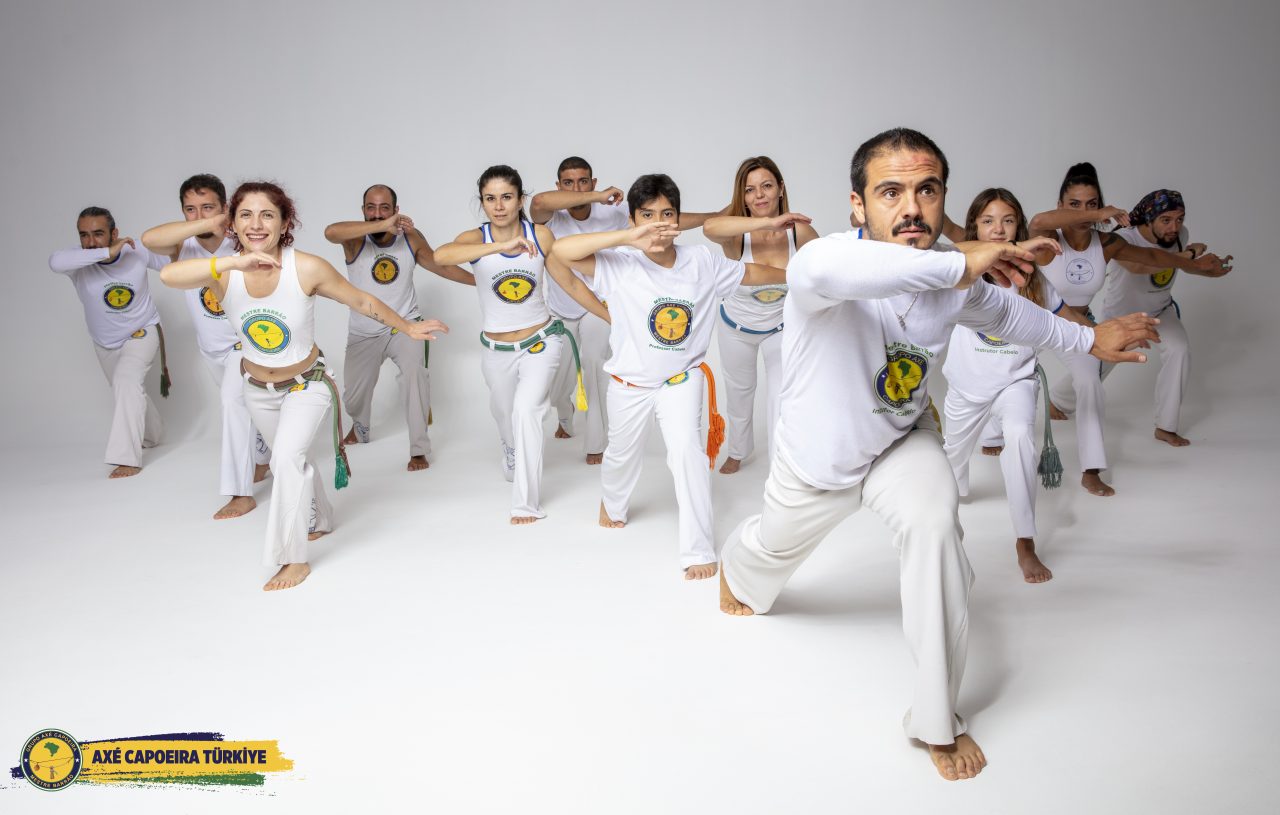
Many people who see capoeira in videos and get curious ask the same questions before their first class: ‘I’ve never done sport, is that OK?’, ‘I can’t do a cartwheel, is that a problem?’, ‘What should I wear?’ In this article we explain step by step what awaits you in your first class.
What to know before your first class
You don’t need a sports background, flexibility or fitness to start capoeira. People of every level train together, and the instructor adapts the moves to the newcomer’s level. Cartwheels and handstands come with time, once the basics are in place.
We recommend arriving 10–15 minutes early. You’ll meet the instructor and can mention any health issues in advance (back, knee or shoulder problems, for example). This makes it easier for them to show you suitable alternative moves.
What to wear and what to bring
No special clothing is needed for the first classes. Comfortable tracksuit bottoms and a T-shirt are enough. The white trousers (abadá) and cord (corda) worn in capoeira come later, once you join the group.
- Capoeira is done barefoot, so you don’t need shoes.
- Bring a bottle of water and a small towel.
- Take off jewellery, watches and necklaces.
- Don’t eat a heavy meal right before class.
What happens in class?
The flow varies from group to group, but a class usually has these parts.
Warm-up
The class begins with a warm-up that loosens the joints and raises the heart rate. It is often done to music and includes simple versions of capoeira-specific moves.
Ginga and basic moves
The ginga is capoeira’s basic step. This constant side-to-side swaying movement is the starting point for every other technique. You’ll spend quite a lot of time on the ginga in your first class. Then come simple kicks (such as meia lua de frente) and escapes (esquiva). If you’re curious about the names of the moves, take a look at our capoeira movements guide.
Partner work
Capoeira is played with a partner, not alone. In class you try the moves you learn with a partner, without contact and in a controlled way. One kicks, the other escapes; then you switch roles.
Music and the roda
At the end of the class a roda is usually formed. Everyone makes a circle, instruments are played, songs are sung and two people at a time play in the middle. You don’t have to enter the roda in your first class. Clapping and singing along with the choruses is also part of the roda.
How will you feel after your first class?
It’s normal to feel muscle soreness in your legs and arms the next day. Capoeira works muscles we rarely use in daily life. The soreness passes within a few days and decreases with regular classes.
After their first class, most people talk less about the moves and more about the music and the group atmosphere.
Frequently asked questions
I’ve never done sport. Can I start capoeira?
Yes. Most people in our classes started capoeira from zero. Fitness and flexibility develop with the classes.
Will it be awkward if I come alone?
No. Everyone who joins the group came alone one day. In roda culture, playing with newcomers and helping them is perfectly normal.
After how many classes will I see progress?
It varies from person to person. People who come to two classes a week regularly usually feel comfortable in the ginga within a few weeks and start doing the basic moves fluidly.
I’m older. Can I still come?
Yes. We cover this in detail in our article capoeira for adults.
Your first class is free
The easiest way to understand capoeira is to come to a class. In Axé Capoeira Türkiye groups the first class is a free trial. Grab your comfortable clothes and come.
Read more
New to capoeira? Start with our guide What is capoeira and how is it played?.
Contact us for a free trial class
For class times and venues, see your city’s page: Istanbul, Ankara, Bursa, Antalya, Trabzon, Sinop, Şanlıurfa. See you in the roda. Axé!