

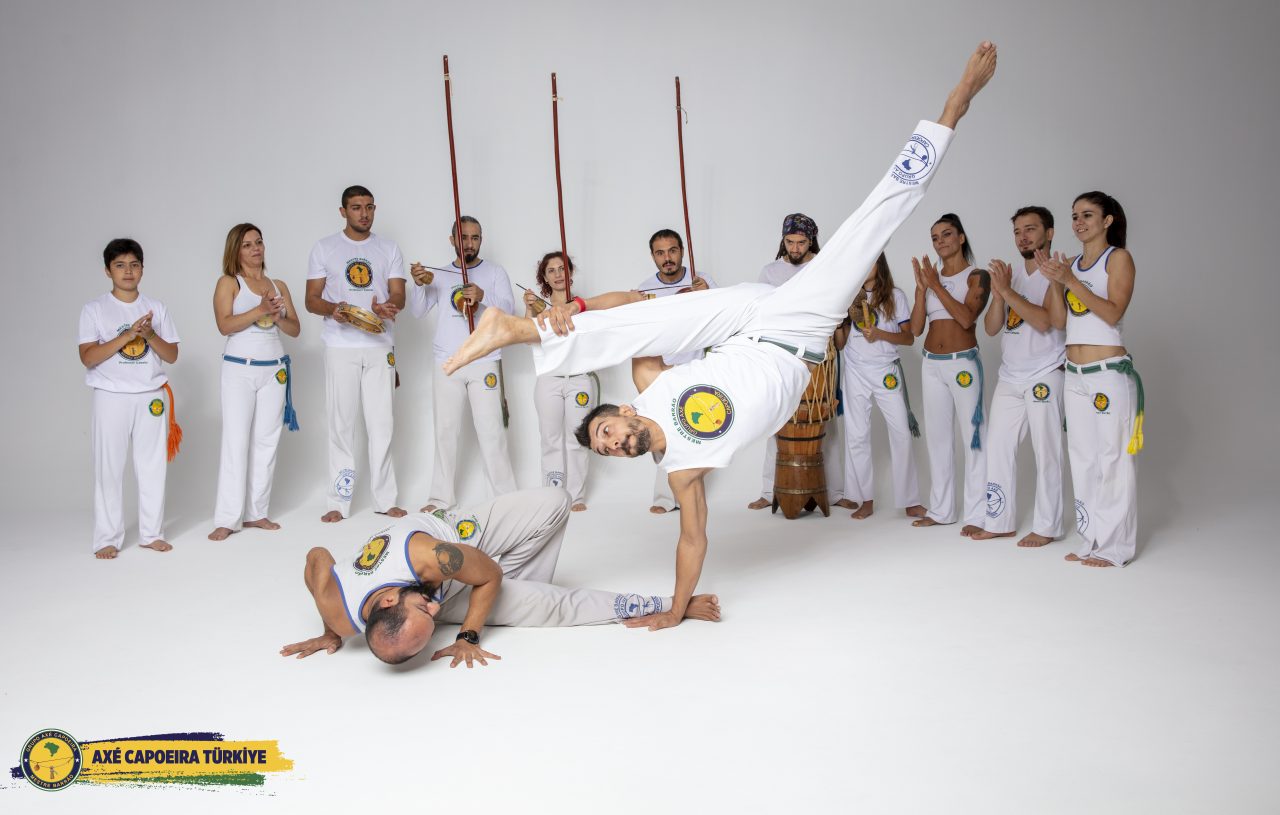
Capoeira moves have Portuguese names that sound unfamiliar in the first classes. In this guide we briefly explain the moves beginners hear most often, what they mean and what they are used for in the game. How the moves are performed can vary slightly from group to group; always learn the correct technique from your instructor.
Ginga: where everything begins
The ginga is capoeira’s basic step. The word means ‘to sway’. As the feet move back and forth, the body stays in constant motion and the arms protect the face.
The point of the ginga is never to be a fixed target. A player who keeps moving is always ready both to escape and to attack. Every kick, escape and acrobatic move comes out of the ginga and returns to it. That’s why most of the first classes are devoted to the ginga.
Kicks (golpes)
In capoeira most attacks are done with the legs. The most common are:
- Meia lua de frente: A kick in which the leg swings in front of the body in a half-moon, from inside to outside. It’s one of the first kicks beginners learn.
- Queixada: Similar to meia lua de frente, but the leg swings from outside to inside.
- Armada: A spinning kick thrown with a turn of the torso, drawing a wide arc.
- Meia lua de compasso: A powerful kick thrown while the hands are on the floor and the body turns. It’s one of capoeira’s best-known moves.
- Martelo: A side kick thrown with the top of the foot. Its name means ‘hammer’.
- Bênção: A front push kick thrown with the sole of the foot.
Escapes (esquivas)
In capoeira the basic idea is to escape an incoming kick rather than block it. That’s why escapes are just as important as kicks.
- Esquiva: Escaping under or to the side of a kick by bending the body or sliding sideways. There are variations in different directions.
- Cocorinha: An escape done by squatting and protecting the head with one arm. One of the simplest and safest escapes.
- Negativa: A low defensive position very close to the ground, with one leg extended and the other bent. From here you can move into a counter-attack.
- Rolê: Moving across the floor by turning on hands and feet. Often used to come out of the negativa.
Sweeps and takedowns
- Rasteira: Sweeping the opponent’s supporting foot to break their balance. One of capoeira’s oldest and most effective techniques.
- Tesoura: Taking the opponent down by using the legs like scissors. An advanced technique.
In class these techniques are practised in a controlled way, with care for your partner’s safety.
Acrobatic moves (floreios)
Acrobatic moves add beauty and surprise to the game. Some of them:
- Aú: Capoeira’s cartwheel. It looks like a gymnastics cartwheel, but the eyes stay on the partner and the movement is more controlled. At first it’s taught close to the ground with bent legs.
- Macaco: The ‘monkey’, a backward move done with one hand placed on the floor.
- Queda de rins: A position in which the elbow rests against the waist and the body balances sideways. It is the basis of many acrobatic moves.
- Bananeira: The handstand in capoeira.
Acrobatics are not a compulsory part of capoeira. There are capoeiristas who play an excellent game without ever doing a cartwheel.
How are the moves learned?
In capoeira moves aren’t memorised one by one. They are learned first alone, then with a partner, and finally in the game, in the roda, with music. A kick only makes sense together with the escape that answers it. That’s why, from the first classes, moves are usually practised in pairs, like a question and an answer.
If you’re curious which moves you’ll start with in your first class, take a look at our article your first capoeira class.
Frequently asked questions
Which move should I learn first?
The ginga. All the other moves are built on it.
Are capoeira moves dangerous?
In class, moves are taught without contact, in a controlled way and according to level. Acrobatic moves come only after the basics are in place.
Can I learn the moves from videos?
Videos give you an idea, but capoeira is played with a partner and with music. Working on the right technique and timing with an instructor also reduces the risk of injury.
Try the moves yourself
Reading only goes so far. The best way to understand the ginga is to take the first step. In Axé Capoeira Türkiye groups the first class is a free trial.
Read more
- Capoeira Angola and Capoeira Regional: What Are the Differences?
- What is a Batizado? How the Capoeira Cord System Works
New to capoeira? Start with our guide What is capoeira and how is it played?.
Contact us for a free trial class
For class times and venues, see your city’s page: Istanbul, Ankara, Bursa, Antalya, Trabzon, Sinop, Şanlıurfa. Axé!