

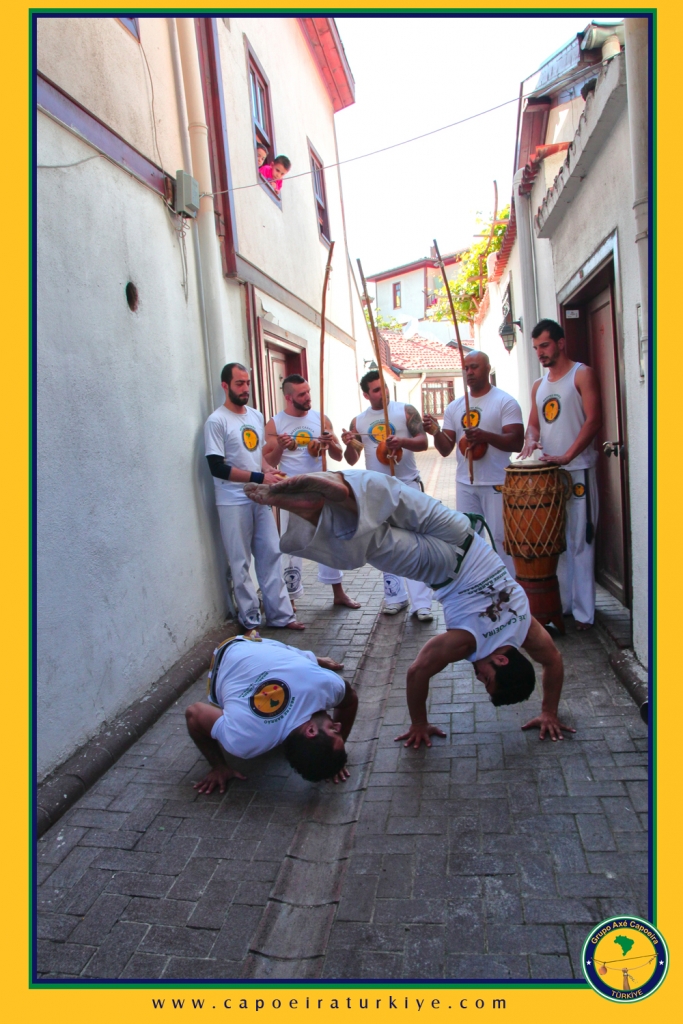
Everyone who starts capoeira hears two names at some point: Angola and Regional. These are capoeira’s two main styles. They share the same roots but developed in different directions in the 20th century. In this article we explain where the two styles come from and how they differ.
A short history
Capoeira was developed by Africans brought to Brazil as slaves and by their descendants. Even after slavery was abolished in 1888, it was associated for many years with the streets and crime, and it was banned in Brazil for a time. You can read more about the history of capoeira on our Capoeira page.
In the first half of the 20th century, two masters in Salvador worked to bring capoeira out of the shadow of the ban and turn it into a respected art: Mestre Bimba and Mestre Pastinha. Today’s two styles are largely the legacy of these two masters.
Capoeira Regional and Mestre Bimba
In the 1930s in Salvador, Mestre Bimba developed a new system for teaching capoeira under the name ‘Luta Regional Baiana’. His aim was to make capoeira more effective and teachable. He created a structured class format, set sequences of movements (sequências) and a graduation system showing students’ progress. He was one of the first masters to teach capoeira in an indoor academy.
General characteristics of Regional:
- A faster, more upright and more athletic game.
- A more direct game in which kicks and counter-attacks are more prominent.
- Music usually with one berimbau and two pandeiros.
- Fast berimbau rhythms such as São Bento Grande.
Capoeira Angola and Mestre Pastinha
Mestre Pastinha aimed to preserve capoeira’s African-rooted traditions and founded his Capoeira Angola school in Salvador in the 1940s. For Pastinha, capoeira was as much a philosophy and way of life as a fighting technique.
General characteristics of Angola:
- A slower, more strategic game played closer to the ground.
- An approach to the game in which cunning, patience and wit (malícia) come first.
- Great importance given to rituals and tradition.
- A larger bateria, usually with three berimbaus, pandeiros, atabaque, agogô and reco-reco.
- Most Angola groups have no cord system.
Contemporânea: capoeira today
Today a large share of the world’s capoeira groups work with an approach called contemporânea (contemporary), born from combining the two styles. In these groups the game changes with the rhythm played in the roda: slow and close to the ground to the Angola rhythm, fast and open to São Bento Grande.
Axé Capoeira, under the leadership of Mestre Barrão, is a group that draws on the heritage of both traditions and is taught in many countries around the world. You can get to know our group better on our Grupo Axé and Mestre Barrão pages.
Which is better?
Both styles are legitimate and valuable faces of capoeira. One emphasises speed and athleticism, the other tradition and strategy. Over the years many capoeiristas try to get to know both and take something from each. For a beginner, a good instructor and a group where they feel they belong matter more than the choice of style.
If you’re curious about the role of music in these styles, see our article capoeira musical instruments.
Frequently asked questions
Which style should a beginner choose?
Look at the group and the instructor more than the style. In contemporary groups you learn the foundations of both.
Is Angola easier because it’s slower?
No. Playing slowly and close to the ground takes serious strength, balance and control.
Can you switch from one style to the other?
Yes. The foundations are shared, so switching is possible, but getting used to each style’s rituals and approach to the game takes time.
Get to know capoeira in the roda
Reading about its history is one way to understand capoeira. The other is stepping into the roda. In Axé Capoeira Türkiye groups the first class is a free trial.
Read more
- Mestre Pastinha, CECA and the 1966 Dakar Festival
- Capoeira Movements: A Guide to Ginga, Aú, Meia Lua and the Basics
- What is an Abadá? The Story of the Capoeira Trousers
Contact us for a free trial class
For class times and venues, see your city’s page: Istanbul, Ankara, Bursa, Antalya, Trabzon, Sinop, Şanlıurfa. Axé!