

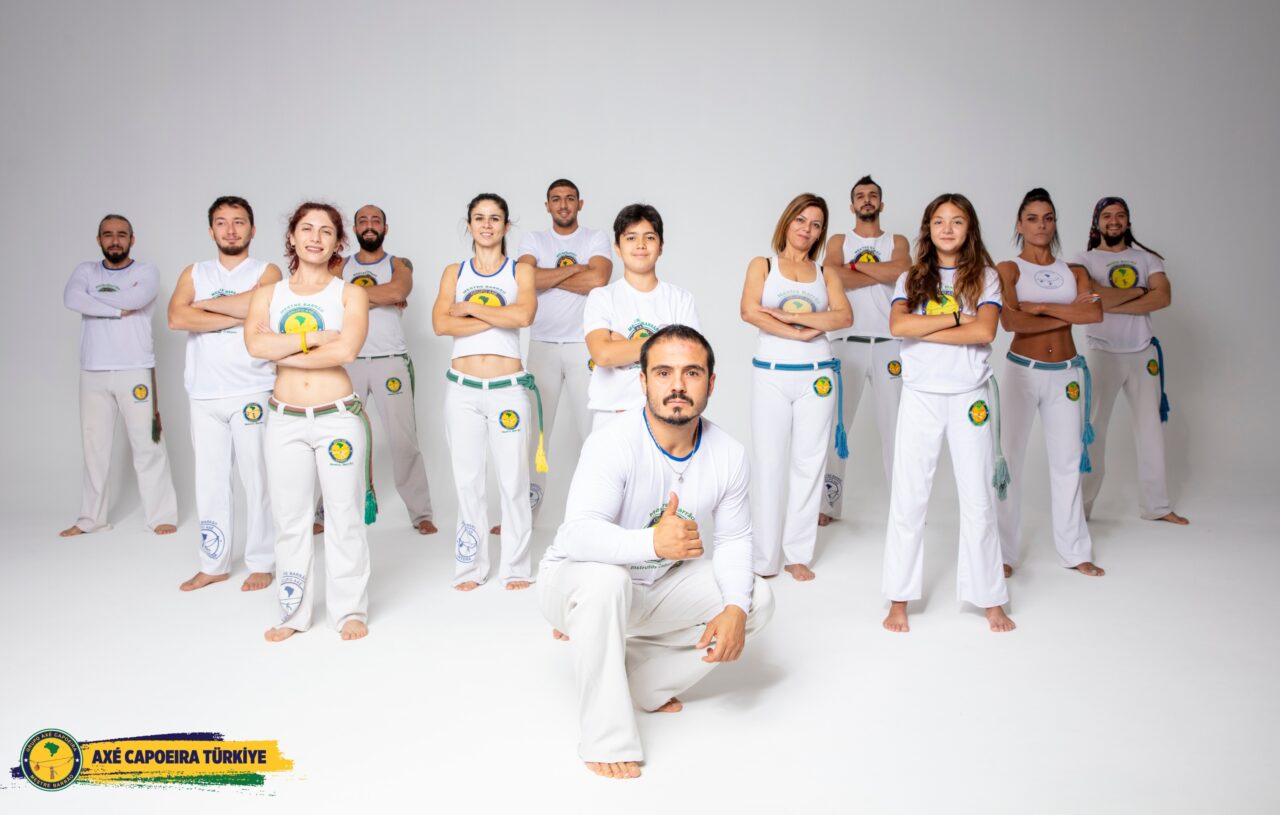
Everyone who starts capoeira soon learns a new word: abadá. In capoeira, abadá is the name for the trousers we wear in class, with an elastic waist, loose around the knees and usually white. Groups generally print their logo on the left leg.
The word is much older than capoeira and originally referred not to trousers but to a long tunic. In this article we explain where the word abadá comes from, how the tradition of white clothing began in capoeira, and how its use as the name for capoeira trousers is a relatively recent development.
The origin of the word: Yoruba agbádá
Abadá comes from the Yoruba word agbádá, from the language spoken in West Africa. An agbádá is a loose, long tunic with wide sleeves worn by men. The word entered Portuguese with Africans brought to Brazil in slavery.
In Brazil, abadá was for a time the name of the white tunic worn for prayer by African Muslims in Bahia. Sources also mention the word being used for the work clothes of dock workers. So for a long time abadá was a word linked not to capoeira but to everyday and religious clothing.
What did early capoeiristas wear?
In the 19th century capoeira had no set uniform. Capoeiristas played in the street in their work clothes or everyday wear. Descriptions of 19th-century capoeiras in Rio de Janeiro mention wide-legged trousers, hats and scarves tied around the neck, but these were the street fashion of the time, not clothing set by a school.
Since capoeira was banned during and after slavery, it would hardly have been possible to establish a dress code that made capoeiristas recognisable anyway. We cover the years of the ban in our article on the 1890 Penal Code.
The white uniform: Mestre Bimba’s choice
The idea of a standard outfit in capoeira came in the 1930s, when capoeira moved indoors. Mestre Bimba, founder of Capoeira Regional, dressed his students in white uniforms. The commonly told reason is practical: white shows dirt immediately. At a time when capoeira was associated with vagrants, a clean white uniform showed that students were tidy and disciplined.
Clean white clothing was a rule in Bimba’s academy. That most contemporary capoeira groups wear white today goes back to this tradition. We describe Mestre Bimba’s method in our article Angola and Regional.
Angola’s colours: yellow and black
A different tradition developed in Capoeira Angola. At his Capoeira Angola centre (CECA), Mestre Pastinha dressed his students in yellow and black, the colours of Ypiranga, the Salvador football club he supported.
Today black trousers and yellow T-shirts are still seen in many Angola groups. Some Angola groups play in shoes, with their shirts tucked in, a nod to the old capoeira played in everyday clothes on the street. We introduce Pastinha in our article Mestre Pastinha, CECA and the 1966 Dakar Festival.
When did the trousers become the abadá?
According to the sources we consulted, calling capoeira trousers abadá began to spread in the late 1970s, and in the 1980s the word became established in capoeira circles. The date isn’t certain; there is no clear document showing in which group, or by whom, the word was first used in this sense.
The ABADÁ-Capoeira group, founded by Mestre Camisa in Rio de Janeiro in 1988, also played a part in spreading the word. The group’s name is an acronym of the Portuguese for ‘Brazilian Association for the Support and Development of the Art of Capoeira’ and is spelled the same as the word abadá. It is now one of the largest capoeira groups in the world.
An interesting detail: the colourful T-shirts worn by participants in the Bahia carnival, also called abadá today, took their name from the capoeira abadá in the 1990s. So the word travelled from Africa to capoeira, and from capoeira to carnival.
Clothing and respect in the roda
In capoeira, clothing isn’t just about comfort. In many groups, entering the roda in a clean, complete uniform is part of the respect shown to the masters and other players. At ceremonies like the batizado this matters even more: students enter the roda in the group’s official abadá and T-shirt, with their cords tied.
The cleanliness rule of Bimba’s academy lives on in many groups today. Small rules, such as keeping the abadá spotless, tucking the T-shirt into the trousers or not wearing jewellery, vary from group to group. You’ll learn them from your instructor over time.
What to look for when choosing an abadá
Once you start coming to classes regularly, you’ll get your group’s abadá. Groups usually supply their own abadá, so that the colour, cut and logo are the same for everyone. If you’re buying one yourself, a few points are worth keeping in mind.
The fabric should be stretchy; in capoeira the legs open wide, and stiff fabric both restricts movement and tears quickly. The elastic waist shouldn’t squeeze, but it should hold the trousers up when you’re upside down. Slightly narrow ankles stop the trousers slipping down on the floor and in inverted positions. Washing a white abadá in cold water and separately from coloured clothes keeps it white for longer.
The abadá today
Today the abadá is part of a capoeira group’s identity. In general:
- Colour: White in most contemporary groups; mostly black or dark in Angola groups.
- Logo: The group’s logo is usually printed on the left leg.
- Cut: Elastic waist, slightly narrow below the knee, comfortable for high kicks and floor movement; the fabric is usually stretchy.
- Cord: The cord (corda) showing the student’s level is tied at the waist of the abadá.
- Training and performance: Some groups wear a plain abadá in class and an official abadá with the logo for performances and batizados.
Frequently asked questions
Do I have to wear an abadá to my first class?
No. Comfortable tracksuit bottoms are enough for the first classes. As you keep coming, you’ll get your group’s abadá.
Why is the abadá white?
The white uniform tradition goes back to Mestre Bimba. In the years when capoeira was associated with vagrancy, clean white clothing showed students’ discipline.
Is the cord tied over the abadá?
Yes. The cord (corda) is tied at the waist of the abadá. We explain the cord system in our batizado article.
One day you’ll wear your own abadá
It’s fine not to have an abadá for your first class; comfortable tracksuit bottoms are enough. What matters is stepping into the roda. If you’d like to get to know the moves, see our article capoeira movements. In Axé Capoeira Türkiye groups the first class is a free trial.
Read more
New to capoeira? Start with our guide What is capoeira and how is it played?.
Contact us for a free trial class
For class times and venues, see your city’s page: Istanbul, Ankara, Bursa, Antalya, Trabzon, Sinop, Şanlıurfa. Axé!