

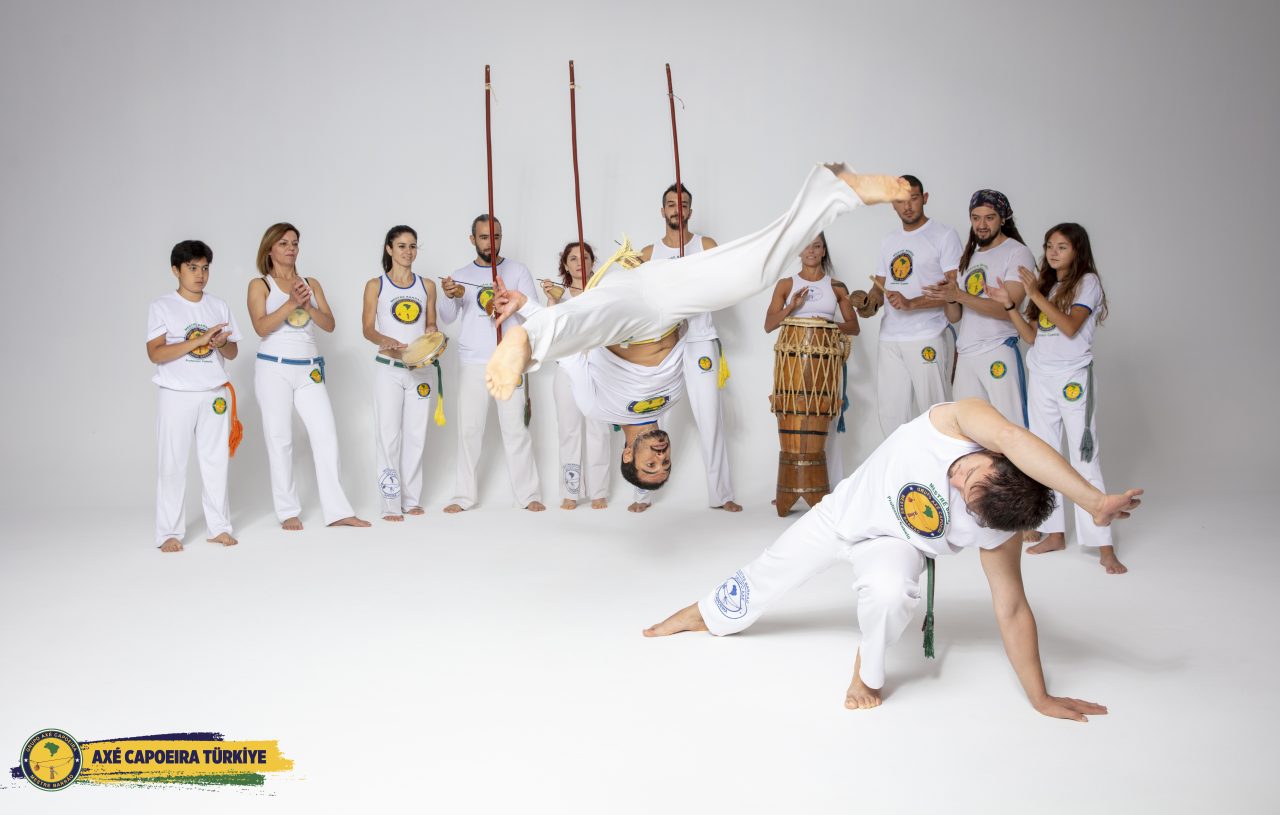
The most distinctive thing that sets capoeira apart from other martial arts is music. The roda doesn’t start without it. Instruments and songs set the speed, style and mood of the game. In this article we explain the instruments used in capoeira and their role in the roda.
Bateria: the capoeira orchestra
The group of people playing instruments in the roda is called the bateria. It is usually lined up side by side on one edge of the roda. Which instruments are used, and how many of each, can vary by group and capoeira style.
Berimbau: the leader of the roda
The berimbau, the symbol of capoeira, is a single-string musical bow. It consists of a long wooden bow, a tensioned steel wire and a gourd (cabaça) that acts as a sound box. The player strikes the wire with a stick (baqueta) held in one hand and changes the sound by pressing the wire with a stone or coin (dobrão) held in the other. A small basket rattle called the caxixi is held in the same hand as the stick.
There are usually three berimbaus in the roda:
- Gunga: The deepest-sounding berimbau. It leads the roda, setting when the game starts, its rhythm and when it ends.
- Médio: The middle-pitched berimbau. It answers the gunga’s rhythm.
- Viola: The highest-pitched berimbau. It adds colour to the music with improvisations.
The rhythms played on the berimbaus are called toques. Angola, São Bento Pequeno, São Bento Grande and Iúna are toques you’ll hear often. Each toque signals a different style of game: one calls for a slow game close to the ground, another for a fast, open game.
Players show respect to the berimbau in the roda. The game starts at the foot of the berimbau and ends when the berimbau gives the signal.
Pandeiro
The pandeiro is a tambourine with jingles, essential to Brazilian music. Usually one or two pandeiros are played in capoeira. They support the berimbaus’ rhythm and bring life to the music.
Atabaque
The atabaque is a tall hand drum that stands upright on the floor. It is of African origin and is used in many areas of Afro-Brazilian culture in Brazil. In the roda it keeps the music’s basic beat and raises its energy.
Agogô and reco-reco
- Agogô: A percussion instrument made of two joined metal bells, played with a stick. It produces two different pitches.
- Reco-reco: A notched instrument played by scraping it with a stick. It is usually made of bamboo or metal.
Songs
Songs are as much a part of the roda as the instruments. Capoeira songs are in Portuguese and sung in call-and-response: one person sings and the roda answers with the chorus (coro). Some types of song:
- Ladainha: A long, narrative song sung by one person at the start of the roda.
- Chula: The section of greetings and praise that follows the ladainha.
- Corrido: Short songs with a chorus sung throughout the game.
The songs tell the history of capoeira, the masters, slavery, freedom and everyday life. You can find the lyrics of Mestre Barrão’s songs on our Music page.
Do you have to learn music?
Because music is an inseparable part of the game in capoeira, classes also teach playing instruments and singing. Nobody is expected to be a great musician. But singing along with the choruses, recognising the basic rhythms and eventually playing an instrument are a natural part of a capoeirista’s journey. In many groups, musical knowledge is also considered when cords are awarded; we explain this in our article the batizado and the cord system.
Frequently asked questions
Is it hard to learn to play the berimbau?
You can learn the basic rhythm in a few weeks. Controlling the grip and the sound takes time, but it’s taught step by step in class.
Do I need to buy my own berimbau?
Not at the start. In class you play the group’s instruments.
Can I sing without knowing Portuguese?
Yes. The choruses are short and repetitive. You’ll learn the words and their meaning over time.
Hear the sound of the roda live
Hearing the berimbau live in a roda is a completely different experience. In Axé Capoeira Türkiye groups the first class is a free trial.
Read more
- Where Does the Berimbau Come From? Its African Origins and Journey into Capoeira
- The Berimbau in Old Records: Drawings, Travellers’ Notes and African Traces
- Samba de Roda and Capoeira: Two Traditions of the Same Roda
New to capoeira? Start with our guide What is capoeira and how is it played?.
Contact us for a free trial class
For class times and venues, see your city’s page: Istanbul, Ankara, Bursa, Antalya, Trabzon, Sinop, Şanlıurfa. Axé!