

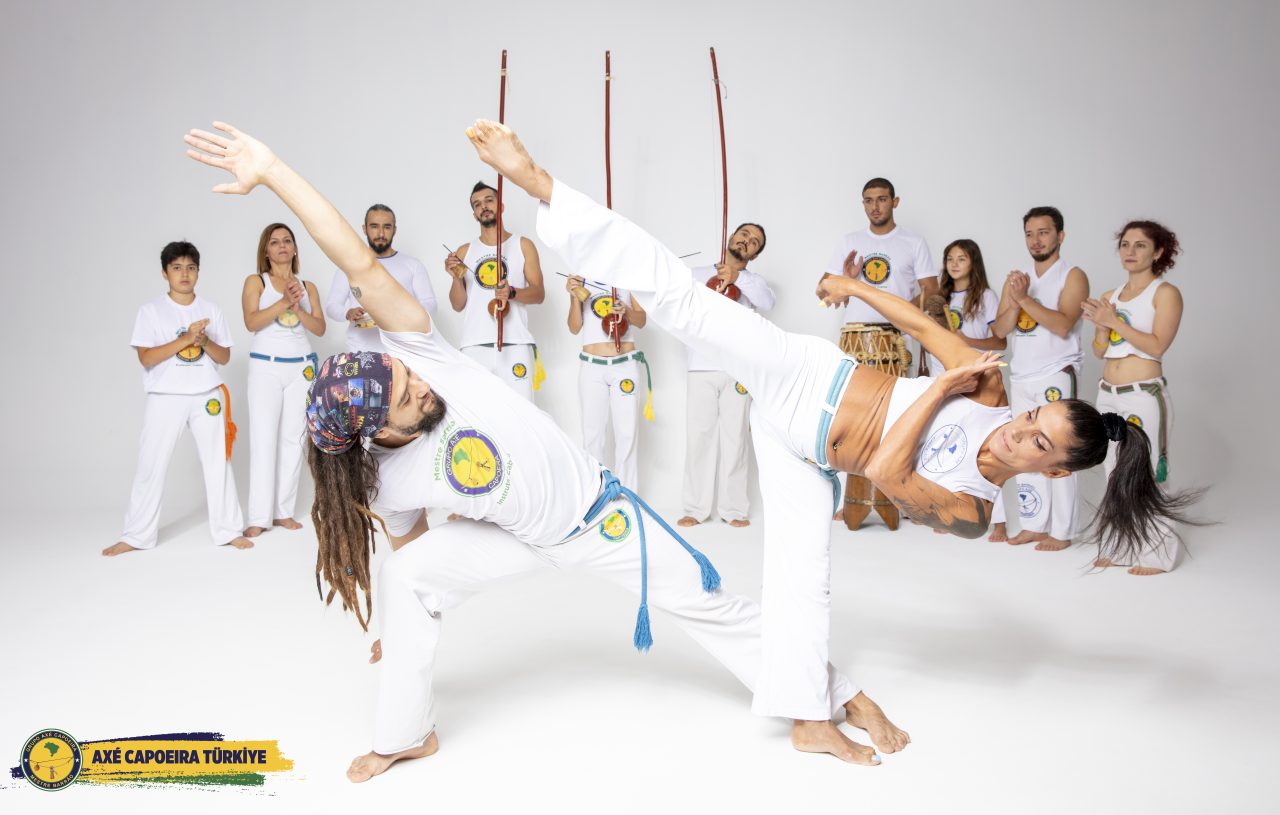
Many people who join a gym and quit a few weeks later say the same thing: ‘I got bored.’ Minutes on the treadmill drag on and weight routines become repetitive. Capoeira offers another way to stay fit: moving with music, play and a group, often forgetting that you’re exercising.
What does capoeira train?
Endurance
In a capoeira class you barely stop from the warm-up to the roda. The ginga requires constant movement, and kicks and escapes come one after another. Your heart rate stays high throughout, and endurance improves noticeably within weeks.
Muscle strength
There’s no weightlifting in capoeira, but body weight is used in every direction. Low stances work the legs and glutes, moves with the hands on the floor work the shoulders and arms, and turns and balances work the core and lower back. The result is a workout that strengthens the whole body in a balanced way, not just one area.
Flexibility and mobility
High kicks, low positions like the negativa and acrobatic moves gradually open up the hips, hamstrings and shoulders. You don’t need to be flexible to start; flexibility develops naturally with regular classes.
Balance and coordination
Watching your partner while turning on one foot, going down to the floor on your hands and coming back up, staying with the rhythm of the music… Capoeira constantly trains the connection between brain and body. Balance and coordination are among the most important skills to preserve as we age.
Does capoeira help you lose weight?
Because capoeira is intense, sustained movement, it burns a lot of energy. How many calories you burn depends on your weight, the pace of the class and how actively you take part, so it wouldn’t be right to give an exact figure.
For weight control, capoeira’s real strength is that it’s sustainable. Doing an activity you enjoy two or three times a week for months gives far better results than a programme you force yourself through for a month and then quit. If losing weight is your goal, combine capoeira with a balanced diet.
How is it different from the gym?
- Motivation: The music, the group and the game pull you to class. You’ll think ‘maybe I’ll skip today’ much less often.
- Variety: Every class is different. A new move, a new partner, a new song.
- Mental focus: In the roda your mind can’t be anywhere else. The class rests your mind too.
- Community: Belonging to a group is one of the strongest reasons people keep going for the long term.
Avoiding injury
Because capoeira is played without contact and in a controlled way, serious injuries in class are rare. Still, as with any sport, you need to be careful:
- Don’t skip the warm-up.
- Start with the easier version the instructor shows and don’t rush into acrobatic moves.
- If you have back, knee or shoulder problems, tell the instructor and check with your doctor if needed.
- Learn to tell pain from muscle fatigue; stop if you feel a sharp pain.
If you’re hesitating because of your age, read our article capoeira for adults.
Frequently asked questions
How many classes a week should I do?
Two classes a week is a good start for noticeable progress. Over time you can go up to three.
Can capoeira replace the gym?
Because it trains endurance, strength, flexibility and coordination together, for many people it’s a complete workout on its own. It’s also a good complement for those who want to keep going to the gym.
I’m out of shape. Will I be able to keep up?
Yes. Everyone works at their own pace and your fitness improves with the classes.
Your first class is free
If you’d like to try something other than the gym, now is a good time for capoeira. In Axé Capoeira Türkiye groups the first class is a free trial.
Read more
- Capoeira Movements: A Guide to Ginga, Aú, Meia Lua and the Basics
- Your First Capoeira Class: What Happens, What to Wear, How to Prepare
New to capoeira? Start with our guide What is capoeira and how is it played?.
Contact us for a free trial class
For class times and venues, see your city’s page: Istanbul, Ankara, Bursa, Antalya, Trabzon, Sinop, Şanlıurfa. Axé!