

Today the berimbau is the symbol of capoeira. It starts the roda and sets the pace of the game. But this single-string bow wasn’t always associated with capoeira. In the drawings and notes of Europeans who travelled through Brazil in the 19th century, the berimbau usually appears in the hands of a musician playing alone in the street.
In this article we look at the berimbau’s relatives in Africa, its first written records in Brazil and old drawings. You can read it as a continuation of our article Where Does the Berimbau Come From?, which tells the instrument’s journey from Africa more generally. Here we focus more on what the documents and pictures tell us.
Where does the name come from?
The word berimbau is generally accepted to come from mbirimbau in Kimbundu, a language spoken in Angola. In Brazil other names of Bantu origin were also used for the same instrument: urucungo and madimba lungungu are two of them.
The number of names suggests that the instrument didn’t arrive in Brazil from a single place at a single time. People brought from different regions brought their own bow instruments and their own names; over time they all came together under the name berimbau.
Its relatives in Angola: mbulumbumba and hungu
The Austrian musicologist Gerhard Kubik wrote that the berimbau is almost identical to the mbulumbumba of south-western Angola in construction, playing technique and tuning. Some researchers suggest that the bow called hungu, from the Kimbundu and Kongo regions, may be a closer relative of the berimbau. Researchers do not agree on which is the direct ancestor.
According to the records, in Africa these bows mostly accompanied songs and storytelling. So far there is no document showing them played together with a fighting game. The capoeira historian Matthias Röhrig Assunção argues that the meeting of a game based on kicks and head-butts with the musical bow most likely happened in Brazil.
Single-string bows with gourd bodies are played not only in Angola but in other parts of Africa too. For example, the Baganda and Busoga peoples of Uganda call a similar bow sekitulege. That’s why researchers prefer to see the berimbau not as the continuation of a single instrument but as the Brazilian member of a wide family of bow instruments.
The berimbau in drawings
European painters who came to Rio de Janeiro in the early 19th century drew the city’s street life in detail. The French painter Jean-Baptiste Debret’s album of Brazil (Voyage pittoresque et historique au Brésil), published in Paris between 1834 and 1839, is one of the most consulted visual sources of the period.
According to the sources, in the drawings of this period the bow instrument mostly appears in the hands of a street musician: the gourd resting against the body, the wire struck with a stick, the musician playing for passers-by. In these pictures the berimbau is not part of a capoeira roda but the instrument of someone begging or selling.
These drawings need to be read with care. The painters drew what they saw through their own eyes and for their own readers; some details were completed later in the studio. Even so, the instrument’s structure is largely the same as the berimbau we play in the roda today.
The first written records
We find traces of the instrument in written sources in the mid-19th century. In 1859 the French journalist Charles Ribeyrolles, describing the evening dances of enslaved Africans on a farm in the province of Rio de Janeiro, mentions a thin-stringed instrument called the urucungo and links it with the batuque.
In the same years capoeira appeared frequently in police records, but these records make no mention of the berimbau. A Rio police report from 1832 says that capoeiras hid their weapons inside marimbas and pieces of sugar cane; whether the instrument mentioned here was the berimbau is unclear. For the records of the period, see our article Capoeira in 19th-Century Rio Police Records.
How does a single string make so many sounds?
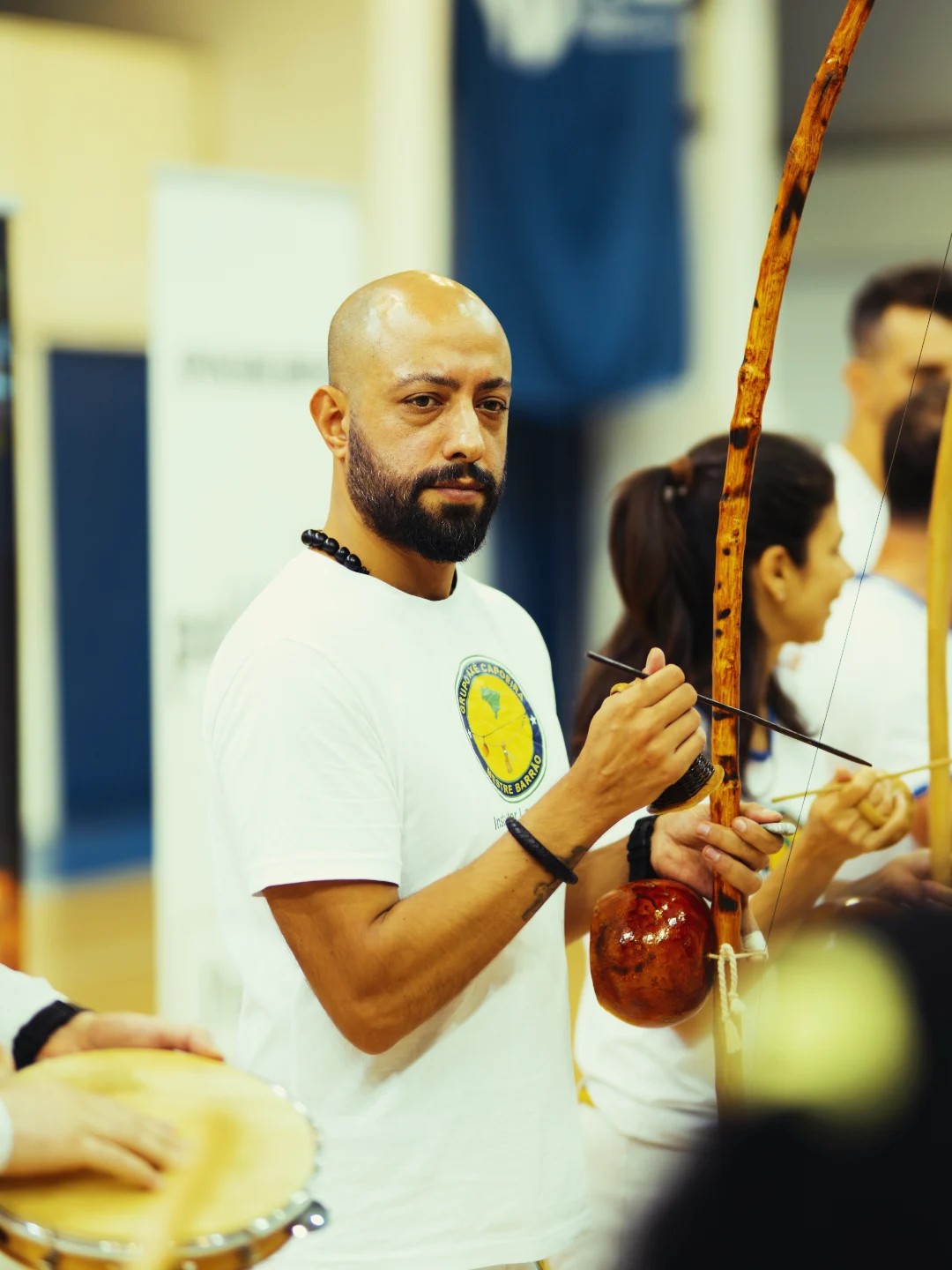
The arrangement, also visible in the old drawings, is actually quite clever. The player holds the bow with one hand; the little finger sits under the cabaça’s string while the thumb and index finger hold the dobrão. With the other hand the player holds the baqueta and caxixi and strikes the wire.
The sound changes in two ways. When the dobrão touches the wire lightly it produces a buzzing, muted sound; when pressed against the wire the pitch rises. And as the cabaça is pressed against the belly and pulled away, the sound opens and closes. In this way several different sounds and a kind of vibrato are produced from a single string.
This technique is used in a similar way on its Angolan relatives. That’s why Kubik found the two instruments identical in playing technique as well.
When did the berimbau become capoeira’s instrument?
According to the sources, records showing the berimbau accompanying capoeira appear in the early 20th century, in Bahia. Before that, the game was accompanied by drums and clapping; over time the berimbau took the drum’s place and moved to the centre of the roda.
Mestre Pastinha recounted that during the years when capoeira was banned, some capoeiristas tied a double-edged blade to the tip of the berimbau, so that the instrument could turn into a weapon when needed. This is a recollection, not a practice confirmed by documents.
What’s interesting is that bow instruments played in other contexts in Brazil became rarer over time. According to Assunção, an important reason the berimbau is so widespread today is capoeira.
Old traces in today’s berimbau
The parts of the berimbau we play in the roda follow the same logic as in the old drawings: the wooden bow called verga, the wire called arame, the cabaça that acts as a sound box, the baqueta that strikes the wire, the dobrão or stone that presses the wire to change the sound, and the caxixi held in the hand. Today there are usually three berimbaus in the roda: the deepest-sounding gunga, the médio that keeps the rhythm and the viola that improvises.
For those who want to get to know the instrument, we describe each part in our article Capoeira Musical Instruments.
- verga: wooden bow
- arame: wire
- cabaça: gourd sound box
- baqueta: stick that strikes the wire
- dobrão or pedra: coin or stone that presses the wire
- caxixi: basket rattle
Frequently asked questions
Did the berimbau come from Africa?
Similar single-string bows are still played in Angola, and the root of the word is in Kimbundu. The instrument’s present form, however, took shape in Brazil.
Does the berimbau appear with capoeira in old drawings?
According to the sources, in 19th-century drawings it mostly appears in the hands of street musicians. Its association with capoeira becomes clear in Bahia in the early 20th century.
When is the berimbau’s first written record?
One of the early known records is the instrument Charles Ribeyrolles described under the name urucungo in 1859.
Listening to the berimbau in the roda
Next time you hear the gunga’s first note in a roda, you can think of the road this instrument travelled from the bows of Angola to the streets of Rio, and from there to the rodas of Bahia. In our classes we also teach berimbau step by step; in the first class, just listening is enough.
Read more
New to capoeira? Start with our guide What is capoeira and how is it played?.
Contact us for a free trial class
For class times and venues, see your city’s page: Istanbul, Ankara, Bursa, Antalya, Trabzon, Sinop, Şanlıurfa. Axé!