

Today we know the early history of capoeira largely from records kept by those who tried to ban it. In the first half of the 19th century the Rio de Janeiro police wrote down, one by one, the people they arrested for playing capoeira: their name, their master, their homeland in Africa, what was found on them and the punishment they received.
A large part of these registers and letters is kept today in the National Archives of Brazil (Arquivo Nacional). In this article we relate what these documents say about capoeira, starting from one arrest file.
29 September 1824: the arrest of Francisco
On 29 September 1824, a police patrol in Rio caught four enslaved men ‘playing capoeira’ at the corner of Rua do Sabão and Rua da Vala. Francisco, recorded as being of Congo origin, was one of them. Francisco was flogged and sentenced to three months on a prison ship anchored in Guanabara Bay and to labour at the navy dock.
Francisco’s owner, Domingos José Fontes, petitioned the emperor for his release, arguing that Francisco had been with him for more than ten years, was well behaved and ill, and so could not possibly have been playing capoeira. The police chief (Intendente Geral de Polícia), Estevão Ribeiro de Rezende, rejected the petition. His reasons: the punishment should serve as an example to other slaves, and the city had long been troubled by capoeiras.
Half the city was enslaved
At that time about 55,000 of Rio’s roughly 112,000 inhabitants were enslaved, most of them born in Africa. Many worked as porters, sailors, craftsmen, public labourers or street vendors; much of their work took place on the street.
The street was therefore not just a workplace but a space for meeting and culture. Sundays and religious holidays were the days when enslaved people could rest and come together. Capoeira was played on these days, in the squares and on street corners.
Capoeira through the eyes of the police
On 9 December 1823 the police chief Rezende wrote to Brigadier Miguel Nunes Vidigal, commander of the Royal Police Guard. He wrote that capoeiras gathered especially on Sundays and holidays and that stabbings and fights increased on those days. He wanted the groups not only dispersed but arrested and punished immediately, in public, and proposed doubling mounted patrols on those days.
Vidigal had been known since the late 18th century for harshly repressing capoeira, batuque and every form of Black gathering. His name even entered ‘Memórias de um Sargento de Milícias’, a classic of Brazilian literature.
Not everyone agreed with this harshness. José Inácio da Cunha, appointed police chief in 1821, criticised the beating of capoeiras without trial and demanded formal charges against those arrested within 48 hours. This approach did not last; for the rest of the century capoeiras continued to face heavy punishments.
Codex 403: 438 arrests
The most important document of this period is Codex 403, the Rio police arrest register for 1810–1821. It recorded the name, offence, punishment and origin of the person arrested, and even their hat and jewellery; for enslaved Africans, their master’s name and their African ‘nation’ were also noted. The historian Carlos Eugênio Líbano Soares describes this register as the largest source of data on the capoeiras of the first half of the century.
The historian Leila Algranti counted 438 capoeira arrests in this register between 1810 and 1821. That made capoeira the second most common reason for arrest in Rio, after running away from slavery. The register also shows that most of those arrested came from West-Central Africa, the region of today’s Congo and Angola.
Punishments were harsh. According to one entry, Joaquim, of Congo origin, received the heaviest punishment of the period for playing capoeira while carrying a knife, scissors and a headdress: 300 lashes and three months of forced labour on the Tijuca road.
1833: ‘they filled the streets’
Repression did not put an end to capoeira. On 26 June 1833 the police chief of the time, Eusébio de Queiroz, complained in a letter that capoeiras openly filled the city’s streets and endangered passers-by by throwing stones on the Campo da Honra. He too wanted those caught to be punishable without trial, and wrote that slave owners often protected their slaves.
The documents show one thing clearly: despite all the repression, capoeira lived on as part of Rio’s street life. This continuity lasted until the end of the century, leading to capoeira being banned by name in the Penal Code of 1890.
What does an engraving tell us?
The engraving ‘Jogar Capoëra’ by the German painter Johann Moritz Rugendas, who was in Rio in the same years, published in 1835, shows something the documents don’t record: the community around the game. In the engraving two players play to a drum and clapping, surrounded by a crowd of men and women; a woman handing out food can also be seen.
The police registers recorded capoeira as a crime; the engraving reminds us that it was also a game that brought people together. We describe the place of women in this history in our article on the women of capoeira.
Frequently asked questions
What are the oldest documents about capoeira?
The oldest and most extensive written documents are the Rio de Janeiro police records of the early 19th century, above all Codex 403, covering 1810–1821.
What was the punishment for playing capoeira at the time?
Flogging and forced labour on public works appear often in the records. In one record the heaviest punishment is 300 lashes and three months of forced labour.
Who were the people arrested?
The great majority were enslaved men born in Africa; according to the records, most came from West-Central Africa, the region of today’s Congo and Angola.
From the documents to the roda
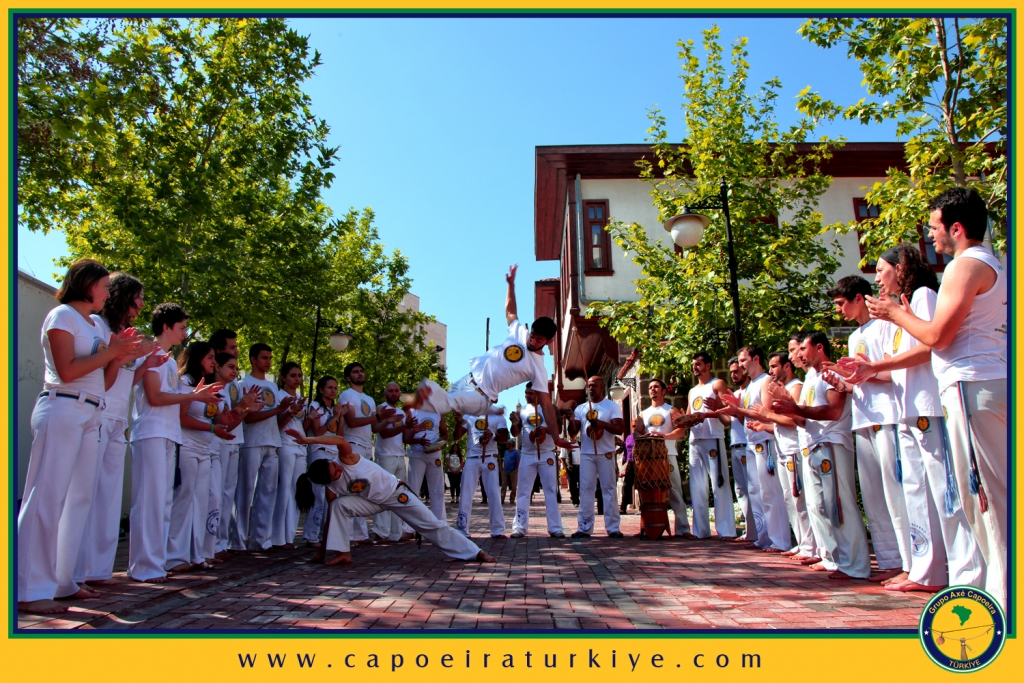
The game of people who were flogged for playing it in the street two hundred years ago is taught all over the world today. In Axé Capoeira Türkiye groups the first class is a free trial.
Read more
- The 1890 Penal Code: Article 402, Which Made Capoeira a Crime
- Nagoas and Guaiamuns: Who Were Rio’s Capoeira Maltas?
- The Women of Capoeira: From Police Records to the Roda
New to capoeira? Start with our guide What is capoeira and how is it played?.
Contact us for a free trial class
For class times and venues, see your city’s page: Istanbul, Ankara, Bursa, Antalya, Trabzon, Sinop, Şanlıurfa. Axé!