

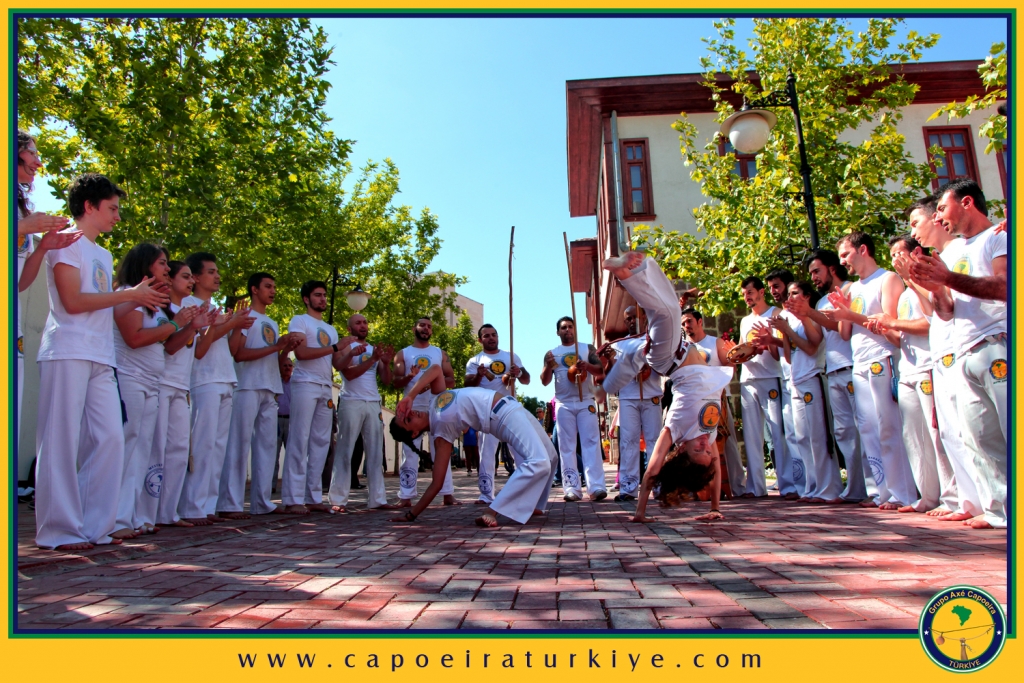
Many capoeira events end the same way: at the close of the roda the berimbaus are put down, the pandeiro and clapping carry on, and people take turns stepping into the middle to dance with small steps. This is samba de roda.
Samba de roda is a tradition that developed in the same region and among the same people as capoeira. The two share the same circle format, similar song types and some of the same instruments. In this article we explain what samba de roda is and why it is so intertwined with capoeira.
A tradition born in the Recôncavo
Samba de roda was born in the Recôncavo, the region surrounding Salvador in the state of Bahia. Taking in towns such as Santo Amaro, Cachoeira and São Félix, the region was known in colonial times for its sugar-cane plantations, and large numbers of enslaved Africans were brought there.
Samba de roda lived on in these communities at festivals, religious celebrations and family gatherings. It is considered one of the roots of the samba styles Brazil is known for around the world today. The Recôncavo is also the homeland of many capoeira masters and of the maculelê tradition.
The first records of samba de roda under that name date back to the 1860s. At the end of the 19th century, Black migrants from Bahia to Rio de Janeiro took the tradition with them. Music historians agree that samba de roda was one of the sources of the samba that developed in Rio and became a symbol of Brazil in the 20th century. The first recorded samba record, ‘Pelo Telefone’, was made in Rio in 1917.
How is samba de roda done?
The basic elements of samba de roda are:
- Roda (circle): Participants form a circle, sing and clap.
- The dancer in the middle: Usually one person dances in the middle of the circle, with feet close to the ground in small, quick steps called miudinho.
- Umbigada: The dancer in the middle hands over their turn by gently turning their belly towards someone else or pointing to them. This traditional gesture of invitation is called the umbigada.
- Instruments: The best known are the pandeiro, the viola machete (a small string instrument), the atabaque and the prato-e-faca, played by scraping a knife across a plate.
- Songs: Sung in call-and-response. Song types such as chula and corrido are also found in samba de roda.
What it shares with capoeira
The similarity between samba de roda and capoeira is obvious at first glance. Both are played in a circle, to music and in turns. In both, everyone in the circle takes part by clapping and singing; there are no spectators, everyone is part of the roda.
The song types are shared too. The chula that follows the ladainha in capoeira and the corrido sung during the game are names also used in samba de roda. The pandeiro and atabaque are played in both traditions. We describe the song types in capoeira in our article capoeira musical instruments.
These similarities are no coincidence. Both traditions lived in Bahia, in the same neighbourhoods and at the same festivals. Many capoeiristas were part of samba de roda as well.
Samba in Mestre Bimba’s academy
According to the sources we consulted, Mestre Bimba included samba de roda and samba duro alongside Capoeira Regional at the graduation ceremonies in his academy. Samba duro is described as a rougher samba game that also included leg sweeps.
Bimba’s choice reflects an approach of keeping capoeira alive together with Bahia’s other Afro-Brazilian traditions. Today many groups still finish batizados and festivals with samba de roda. We describe what happens at a batizado in our batizado article.
UNESCO and IPHAN recognition
Samba de Roda do Recôncavo Baiano was registered in September 2004 by IPHAN, Brazil’s national cultural heritage institute. The study prepared for the registration mapped samba de roda groups in 21 municipalities of the Recôncavo. In 2005 UNESCO proclaimed samba de roda a Masterpiece of the Oral and Intangible Heritage of Humanity. It was the first Brazilian musical tradition to receive this title and was later inscribed on UNESCO’s Intangible Cultural Heritage list.
Capoeira followed a similar path: the Roda de Capoeira was registered by IPHAN in 2008 and added to the UNESCO list in 2014. The recognition of both rodas as cultural heritage to be protected also reflects the shared story of these two Bahian traditions.
A circle open to everyone
One of the most important features of samba de roda is that it is inclusive. It has no fixed time or place; it can start spontaneously at a religious festival, a family celebration or a neighbourhood gathering. Someone there for the first time can join the singing and clapping and, when their turn comes, step into the middle and dance. The capoeira roda has the same spirit: everyone in the circle contributes to the energy of the roda by singing and clapping.
Samba in the roda
In capoeira classes samba de roda is sometimes done as a warm-up, sometimes as a closing. The miudinho steps work the ankles and the sense of rhythm, and clapping and singing in the circle is an easy way to get used to capoeira’s musical side. In samba de roda anyone can step into the middle; the person in the middle tells you when with the umbigada.
Frequently asked questions
Is samba de roda the same as carnival samba?
No. Samba de roda is an old tradition from Bahia’s Recôncavo and is considered one of the roots of the samba school style we see at carnival. It is done in a smaller circle with simple instruments.
Why do capoeira groups do samba?
The two traditions developed together in Bahia and share the same circle format, song types and instruments. Mestre Bimba also included samba de roda in his academy.
Do I need to know how to dance to join a samba de roda?
No. Clapping and singing along is also taking part in the roda. You’ll learn the steps over time in the roda.
A samba at the end of the roda
Capoeira isn’t just a game; with its songs, instruments and samba, it’s a whole culture. In Axé Capoeira Türkiye groups the first class is a free trial.
Read more
- Lei Áurea: 13 May 1888 and the End of Slavery in Capoeira Songs
- Capoeira Angola and Capoeira Regional: What Are the Differences?
New to capoeira? Start with our guide What is capoeira and how is it played?.
Contact us for a free trial class
For class times and venues, see your city’s page: Istanbul, Ankara, Bursa, Antalya, Trabzon, Sinop, Şanlıurfa. Axé!