

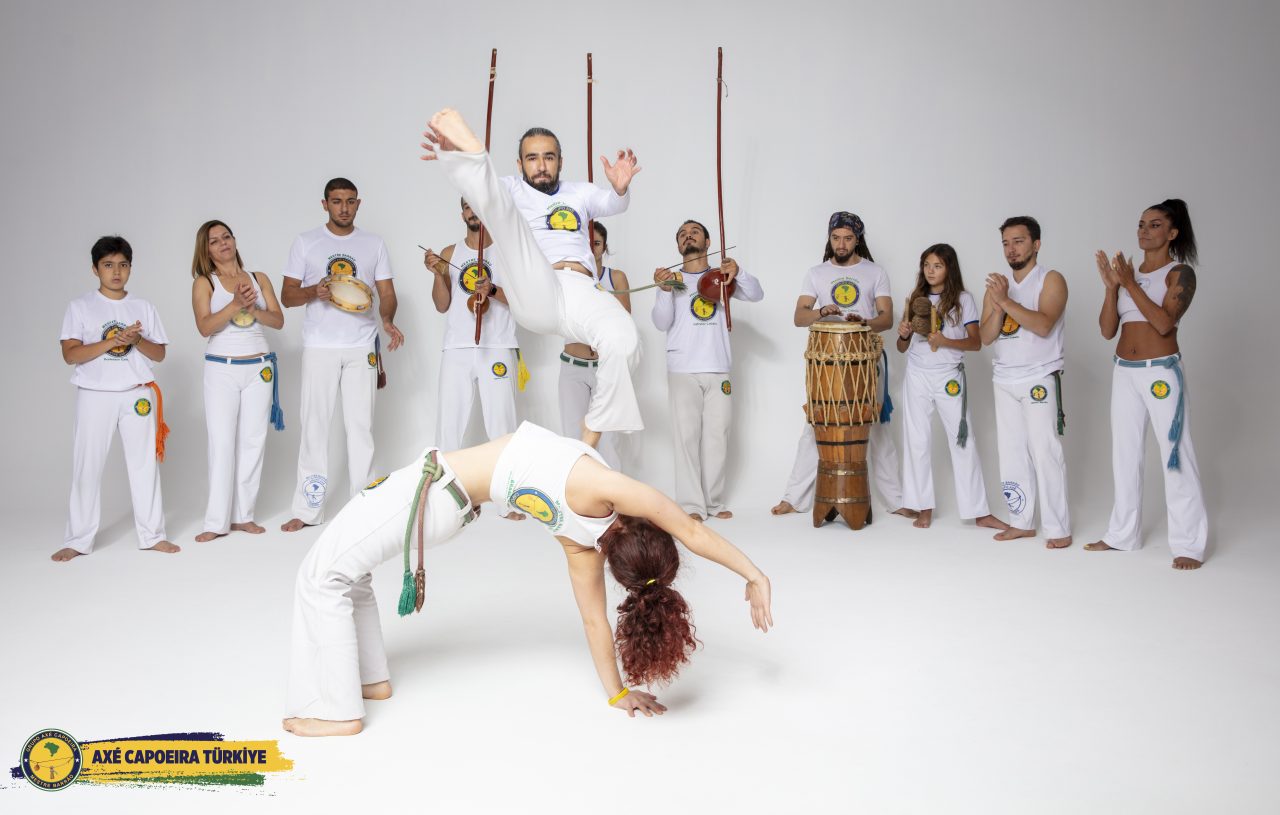
The most distinctive sound of a capoeira roda is the berimbau. The berimbau starts the roda, sets the pace of the game, and the game ends at its signal. Yet the origin of an instrument so closely identified with capoeira today is much older than capoeira itself.
In this article we look at the berimbau’s relatives in Africa, the names it has been known by in Brazil, and how it became capoeira’s indispensable instrument. We describe the parts of the berimbau and its role in the roda in detail in our article capoeira musical instruments.
A bow, a wire, a gourd
The berimbau belongs to the family of instruments musicologists call ‘musical bows’. Its structure is simple: a flexible branch is bent like a bow, a wire is stretched between its two ends and a gourd is attached to the wire. The gourd acts as a sound box (resonator) that amplifies the sound. The player strikes the wire with a stick and changes the sound by pressing the wire with a stone or coin.
Single-string bows with resonators like this are common in many parts of Africa, especially Central and Southern Africa. The berimbau’s direct ancestors most likely also come from these regions, from Bantu-speaking peoples.
Its African relatives
Researchers link the berimbau to several instruments from Angola:
- Hungu: A musical bow of Kimbundu and Kongo origin. Some studies draw a direct line between the berimbau and this instrument.
- Mbulumbumba: A bow with a gourd resonator used in south-western Angola. The musicologist Gerhard Kubik has argued that the berimbau is very similar to this instrument in construction and playing technique.
- Urucungo: One of the names used in Brazil in the 19th century for such bows. The word is linked to instrument names in Angola.
The first traces in Brazil
Musical bows arrived in Brazil with Africans brought there in slavery. European painters travelling through Brazil in the early 19th century depicted these instruments. Among the drawings the French painter Jean-Baptiste Debret made in Rio de Janeiro in the 1820s is a man playing a bow with a gourd resonator.
At that time the musical bow was seen as a solo instrument in the hands of street vendors and beggars. The name berimbau gradually became common for these instruments; some sources trace the word to a term of Kimbundu origin.
When did the berimbau enter capoeira?
A surprising fact: early 19th-century depictions of capoeira show no berimbau. In the German painter Johann Moritz Rugendas’s famous engraving ‘Jogar Capoëra’, published in 1835, the players play to a drum.
Records linking the berimbau with capoeira date from the late 19th and early 20th centuries, especially in Bahia. In the first half of the 20th century, masters in Salvador, including Mestre Bimba and Mestre Pastinha, organised the roda around the berimbau. The berimbau’s role as leader of the roda, setting the start, rhythm and end of the game, was established in this period.
The sources we consulted draw particular attention to one point: there is no document showing that musical bows in Africa were played together with a fighting game there. In other words, the berimbau and capoeira came together in Brazil, within capoeira’s own history.
The engolo debate
Another topic often mentioned in discussions of capoeira’s African origins is engolo, a kicking game played in south-western Angola. Some researchers argue that there are movement similarities between engolo and capoeira. This view is debated; it is accepted that capoeira formed in Brazil through the meeting of different African traditions, but there is not enough evidence to tie it to a single source.
The same goes for the berimbau: the instrument’s African origin is clear, but researchers hold different views on which people’s instrument it descends from.
The berimbau’s language: toques
The berimbau’s authority in the roda comes from the rhythms it plays, the toques. Each toque tells the players what kind of game to play. The Angola toque calls for a slow, low, strategic game; São Bento Grande calls for a fast, open game. Some toques belong to particular situations; for example, in many groups Iúna is reserved for advanced players or exhibition games.
The number and names of toques vary from group to group. Mestre Bimba arranged specific toques for his own academy; the repertoire of Angola groups is different. This variety shows how the berimbau was reshaped in the hands of each master once it entered capoeira. We explain the difference between the styles in our article Angola and Regional.
The berimbau today
Today’s capoeira berimbau usually consists of a bow (verga) made of biriba wood, a steel wire (arame), a gourd sound box (cabaça), a stick (baqueta), a stone or coin to press the wire (dobrão) and a small basket rattle (caxixi) held in the same hand as the stick. It is well known that the wire used to be taken from inside car tyres, and many groups still do this today.
There are usually three berimbaus in the roda, called gunga, médio and viola. Each plays at a different pitch, and together they build the music of the roda.
Frequently asked questions
Does the berimbau come from Africa?
The berimbau descends from the single-string musical bows of Central and Southern Africa. However, there is no document showing these instruments were played with a fighting game in Africa; its union with capoeira happened in Brazil.
Was the berimbau always part of capoeira?
No. In early 19th-century depictions, capoeira is played to a drum. The berimbau settled into capoeira between the late 19th and early 20th centuries, especially in Bahia.
Is it hard to learn the berimbau?
You can learn the basic rhythm in a few weeks. The berimbau is taught step by step in class.
Why does the berimbau’s wire come from car tyres?
The steel wire inside tyres is strong and easy to find. Many berimbau makers still take the wire from old tyres today; ready-made wire is also used.
Hear the berimbau in the roda
Hearing the berimbau on a recording and hearing it in the roda are very different. In Axé Capoeira Türkiye groups the first class is a free trial, and you’ll also get the chance to pick up a berimbau in class.
Read more
- The Berimbau in Old Records: Drawings, Travellers’ Notes and African Traces
- Lei Áurea: 13 May 1888 and the End of Slavery in Capoeira Songs
New to capoeira? Start with our guide What is capoeira and how is it played?.
Contact us for a free trial class
For class times and venues, see your city’s page: Istanbul, Ankara, Bursa, Antalya, Trabzon, Sinop, Şanlıurfa. Axé!